
In the world of artificial intelligence and data science, supervised and unsupervised machine learning play pivotal roles in solving a wide range of real-world problems. From spam email detection to customer segmentation, businesses and researchers rely on machine learning algorithms to derive insights, make predictions, and automate processes.
This blog will explore the top algorithms used in supervised and unsupervised machine learning, highlighting their key features, use cases, and how they work. Whether you’re a data science enthusiast, a student, or a business owner looking to understand the basics, this comprehensive guide is designed to help you navigate the fascinating landscape of machine learning.
What Is Supervised and Unsupervised Machine Learning?
Before diving into the algorithms, let’s clarify what supervised and unsupervised machine learning mean.
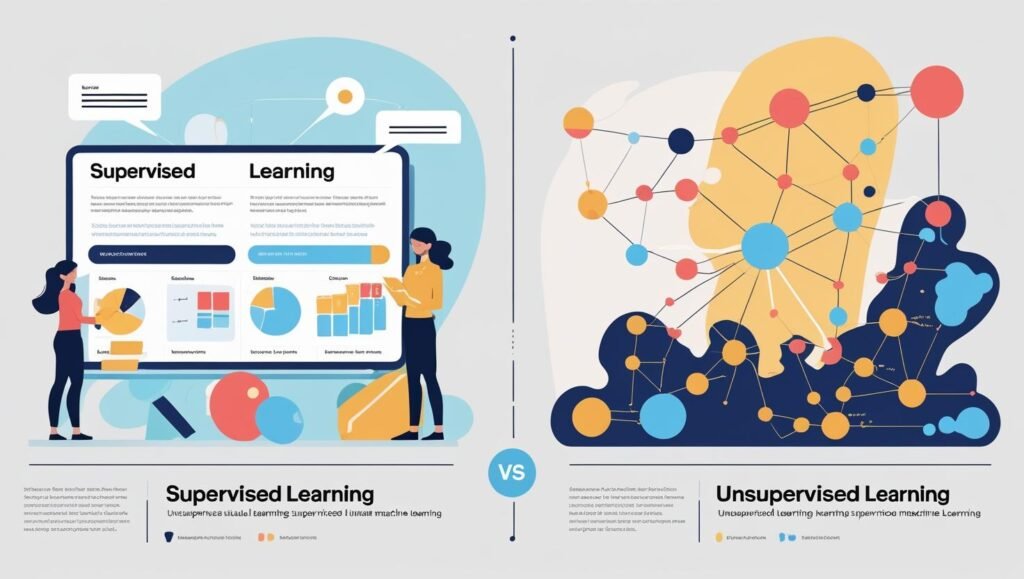
- Supervised Learning involves training a model on a labeled dataset, meaning that each input comes with a corresponding output. The model learns to predict outcomes based on this input-output mapping.
- Unsupervised Learning deals with unlabeled data. The goal is to identify patterns, structures, or groupings in the data without prior knowledge of the outcomes.
These two learning types form the foundation of modern machine learning systems, each serving different purposes in data analysis.
Top Supervised Machine Learning Algorithms
Let’s begin with the most widely used algorithms in supervised machine learning. These are designed to predict outcomes based on input data and are ideal for tasks like classification and regression.
1. Linear Regression
Use Case: Predicting numerical values such as prices, sales, or temperatures.
Linear regression is one of the simplest and most interpretable algorithms in supervised and unsupervised machine learning. It establishes a linear relationship between input variables (independent) and output (dependent).
How it Works:
- Fits a line that minimizes the error between actual and predicted values.
- Works best with linearly correlated data.
2. Logistic Regression
Use Case: Binary classification problems like spam detection or fraud detection.
Despite the name, logistic regression is used for classification. It calculates the probability of a data point belonging to a specific category using the logistic function (sigmoid curve).
Key Features:
- Outputs probabilities.
- Ideal for binary outcomes (yes/no, 0/1).
3. Support Vector Machines (SVM)
Use Case: Text classification, image recognition, and face detection.
SVM is a powerful algorithm that seeks to find the optimal hyperplane that best separates different classes in the dataset.
Why Use It?:
- Effective in high-dimensional spaces.
- Robust against overfitting, especially in complex datasets.
4. Decision Trees
Use Case: Credit scoring, customer segmentation, and medical diagnosis.
Decision trees use a flowchart-like structure to make decisions based on input data. It recursively splits the dataset based on certain features until it reaches a prediction.
Advantages:
- Easy to interpret.
- Handles both numerical and categorical data.
5. Random Forest
Use Case: Stock market predictions, loan approval, and sentiment analysis.
A Random Forest is an ensemble method that creates multiple decision trees and merges their results for more accurate and stable predictions.
Why It Works:
- Reduces overfitting.
- Works well on large datasets with many features.
6. K-Nearest Neighbors (KNN)
Use Case: Recommender systems, handwriting recognition, and pattern recognition.
KNN is a lazy learning algorithm that makes predictions by comparing a new data point to the ‘K’ most similar instances in the training dataset.
Strengths:
- Simple and intuitive.
- Effective in small datasets.
Top Unsupervised Machine Learning Algorithms
Now let’s look at the leading algorithms in unsupervised machine learning. These algorithms help uncover hidden patterns or groupings in data without predefined labels.
1. K-Means Clustering
Use Case: Market segmentation, image compression, and document classification.
K-Means is a partition-based clustering algorithm that divides data into ‘K’ groups based on feature similarity.
How it Works:
- Randomly initializes centroids.
- Iteratively updates clusters to minimize intra-cluster distances.
2. Hierarchical Clustering
Use Case: Gene sequence analysis, document clustering, and social network analysis.
This algorithm builds a hierarchy of clusters using a tree-like structure called a dendrogram.
Types:
- Agglomerative (bottom-up)
- Divisive (top-down)
3. Principal Component Analysis (PCA)
Use Case: Dimensionality reduction, visualization, and noise filtering.
PCA transforms high-dimensional data into fewer dimensions by identifying the most significant components that capture the maximum variance.
Benefits:
- Speeds up training time.
- Reduces overfitting in models.
4. DBSCAN (Density-Based Spatial Clustering of Applications with Noise)
Use Case: Anomaly detection, spatial data clustering, and fraud detection.
DBSCAN groups together points that are close to each other and marks outliers as noise.
Advantages:
- Doesn’t require the number of clusters as input.
- Good for discovering clusters of arbitrary shapes.
5. Autoencoders
Use Case: Image denoising, feature extraction, and anomaly detection.
Autoencoders are neural networks that learn to compress and reconstruct data. They are widely used in unsupervised deep learning.
https://www.geeksforgeeks.org/machine-learning/machine-learning/ why They’re Useful:
- Learn complex representations.
- Suitable for unsupervised feature learning.
For more information
Supervised vs Unsupervised Machine Learning: Key Differences
Understanding the difference between supervised and unsupervised machine learning is crucial to selecting the right algorithm.
| Feature | Supervised Learning | Unsupervised Learning |
|---|---|---|
| Data Type | Labeled | Unlabeled |
| Objective | Prediction | Pattern discovery |
| Examples | Linear regression, SVM | K-means, PCA |
| Complexity | Lower (in most cases) | Higher |
| Output | Classes/values | Clusters/features |
Each type has its own set of algorithms tailored to specific tasks. Choosing the right algorithm often depends on the nature of your data and your end goal.

Applications of Supervised and Unsupervised Machine Learning
Here are some real-world scenarios where supervised and unsupervised machine learning make a huge impact:
Supervised Learning Applications:
- Email spam filtering
- Loan approval systems
- Disease prediction in healthcare
- Product recommendation engines
Unsupervised Learning Applications:
- Customer segmentation in marketing
- Organizing computing clusters
- Pattern detection in cyber security
- Image and speech compression
By combining the strengths of both approaches, businesses can build hybrid systems for smarter decision-making.
Tips for Choosing the Right Algorithm
Selecting the right algorithm in supervised and unsupervised machine learning involves multiple considerations:
- Understand Your Data: Is it labeled or unlabeled?
- Define Your Goal: Prediction vs pattern discovery.
- Evaluate Performance: Use metrics like accuracy, F1 score (for supervised), or silhouette score (for unsupervised).
- Experiment & Tune: Algorithms often require hyperparameter tuning for best results.
Remember, there is no “one-size-fits-all” algorithm. Testing different models and evaluating performance is part of the machine learning workflow.
Final Thoughts
In conclusion, supervised and unsupervised machine learning algorithms are at the heart of intelligent systems. From predictive analytics to pattern recognition, they provide the tools needed to make sense of vast data sets and drive informed decisions.
Whether you’re working with labeled data to predict future outcomes or exploring data to uncover hidden patterns, understanding the top algorithms will give you a strong foundation in machine learning. As the field continues to evolve, mastering these core techniques will be invaluable for anyone interested in data-driven technology.